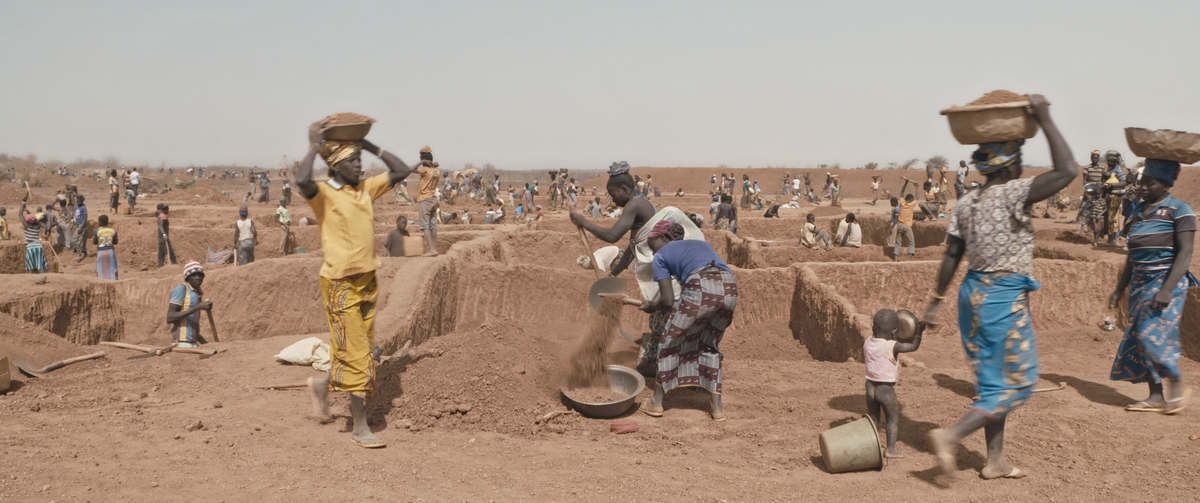
One of the close-ups of The Perimeter of Kamse (2020), by Olivier Zuchuat, shows an army of women, hoes at the ready, looking straight ahead, serious and ready to fight one of the many battles into which the whipped pushes them.
Sahel region. In this case, combating the desertification of their land, around a small town to the east of Ouagadougu, the capital of Burkina Faso, to make it arable, as it was in the time of their grandmothers. The documentary, which narrates the epic of getting food to sprout from dry rocks despite the scarcity of water, won the grand prize at the 16th edition of the International Trans-Saharan Film Festival in Zagora (Morocco), held last November, and continues his journey in European film cycles.
The challenge for these women is to plow a soil that has become stony due to persistent erosion, after decades of overexploitation by human activity (hunting, cutting down bushes and trees to use firewood for cooking) and after a drought. very long, in an area where there was once a much more fertile savannah.
As the women dig to sow and fight the desert, another desert emerges: the state, the health, the educational, the legal.
The obstacles seem more insurmountable when faced with diminished strength, as too many men have left home for the cocoa fields of the Ivory Coast or migrated further afield. That is why in Kamse it is the women who are willing to imitate what the inhabitants of the neighboring town, Goema, did to make the cereal flourish. Thus, once the leaders of the two villages have met, they will also learn first-hand about the ancient Zai technique, a cultivation method used to restore arid lands and increase soil fertility, which consists of collecting water from rainfall and compost in holes dug in the soil during the preplanting season.
Zuchuat, the Swiss film director, records those patient meetings in which details are explained about how to grow trees to delimit a more humid perimeter and productive land, or how to retain rainwater in dikes, in addition to the ways in which The teams will be organized and who can and cannot participate in such a tough task. Parents explain to their children that it was enough for the ancestors to ask for it to rain and, perhaps for this reason, they continue to try it in rituals with prayers, sprinkled with feathers and chicken blood. And sometimes, the miracle of rain occurs. So, the images of the sky with clouds and the drops wetting the sparse vegetation of the place transmit the peace that the Sahel deserves.
What is left when Africans flee
The director also films those endless days and nights of digging and digging in order to plant the first cutting. “It is an agroecological solution that requires extremely simple things,” Zuchuat clarifies, in a telephone dialogue. He recounts that he arrived there in 2016 moved by the drama of migrants dying en masse in the Mediterranean and curious to know what was left in the places from which Africans fled.
Once in Burkina Faso, he found out about these initiatives that would make the illusions of the national martyr Thomas Sankara, assassinated in 1987, green again. 40 years after Sankara’s ascension to the presidency in 1983, “as women dig to sow and fight the desert, another desert emerges, the state, health, educational, and legal,” laments Zuchuat.
Added to this absence of the State is the siege of jihadism in a large part of the Burkinabe territory. In his film, Zuchuat decides to insert this topical note through the distorted sound of a small radio. It’s just a newsletter, but the viewer’s skin crawls.
The slow rhythm of the Pacific Sahel began to change precisely in the years of filming (2016-2018) of this film, when the jihadist attacks had already begun to harass the capital, located some 200 kilometers away, and in the villages the terrible news could be heard in the distant voice of a radio broadcast.
“It was not expected that any reference to jihadism would appear, but the news slipped through the radio,” adds Zuchuat, who clarifies that, since January 2019, the situation is complicated for any foreigner, so filming times had to be shortened. . “All the balances are shaken and society is fractured, in a place where people of all religions were used to living in harmony”, he maintains.
Despite everything, the filmmaker, who had already filmed two other films on the African continent (one about the link between African public debts and money laundering in Switzerland and another about the survivors of the Darfur massacre), brings good news. of this now dangerous territory.
“The Kamse agricultural perimeter is a success,” he enthuses. That fenced area “today has a yield of one ton of sorghum per hectare, while outside the perimeter, the harvest does not reach 600 kilos,” according to Zuchuat.
In Burkina Faso, rain is needed and peace is needed. “If the rain hits you, don’t hit each other too,” a man says from the screen, reciting an old proverb.